Description
The Utility Industry continues to adapt to new regulations, changes in public perception, and emerging market opportunities. Examples of drivers causing change include modernizing and expanding infrastructure, implementing decarbonization solutions, pursuing sustainability policies, reducing cybersecurity threats, and embracing the shift toward green energy. Analytics solutions are key enablers for managing change and pursuing new opportunities.
Analytics effectiveness and impact depend on two types of visualization skills: the ability to create visuals and the ability to understand visuals. The real value of visualization does not come from creating visuals, but from understanding what they tell you. With the language of words, we learn reading and writing as separate but related skills. Similarly, with visual language, we need to learn understanding (reading) and creating (writing) as distinct but related skills.
Data analysts at the top of their game go beyond creating data visualizations. They add narratives to interpret visuals and explain insights and recommendations. In short, they tell data stories. Stories are powerful. Throughout history, we’ve used them to capture attention, convey ideas, fire the imagination, and stir the soul. Data can be persuasive, but stories can be transformational. A well-told story is inspirational. The utility industry is rich with opportunities to deliver well-crafted stories to all of its stakeholders. As society moves toward new energy sources and delivery models, it is essential that data-driven stories are used to educate and guide us through the transition.
On the surface, storytelling may appear to be the opposite of analytics—anecdotal instead of quantitative. But quantities aren’t the only, or even necessarily the best, way to convey information. Not everyone thinks naturally in numbers. Some think in pictures, which explains the popularity of data visualization. Others—a large portion of business professionals—would rather not think about data at all, preferring to understand its meaning through anecdotes, metaphors, and examples.
Storytellers are the new generation of business and data analysts. They don’t dismiss the value of quantification—it remains the foundation. They also don’t devalue the importance of visualization; instead, they amplify it by crafting stories through visuals to communicate the what, when, where, who, and why behind business circumstances and behaviors.
You will learn:
- Ten key concepts of data visualization
- The most important things to look for when reading visualizations
- How to do a “quick read” and a “critical read” of data visualizations
- To see trends, patterns, and outliers in visual presentation of data
- To see ambiguity, distortion, and bias in visual presentation of data
- Four reasons to pursue the art of storytelling
- How to find the stories in data
- How to compose captivating and compelling stories
- Models, frameworks, and patterns for data stories
- How to choose the best media for storytelling
Geared to:
- Business managers, decision makers, analysts and other analytics consumers seeking to refine their skills for understanding data visualizations and delivering data stories to share information
- Energy policy makers, regulatory staff and marketing professionals who need data driven stories to effectively communicate messages to their stakeholders
- Developers of data visualizations who will improve visualization skills by seeing data visualization through the eyes of the readers
- BI and analytics professionals who create dashboards and scorecards for the business
- Data analysts and data scientists who create data visualizations to inform others
- Everyone who needs to explain data visualizations to others, ranging from business managers presenting performance data to data scientists presenting predictions and recommendations
- Everyone who uses data as a tool to inform, influence, and persuade others
Presented by

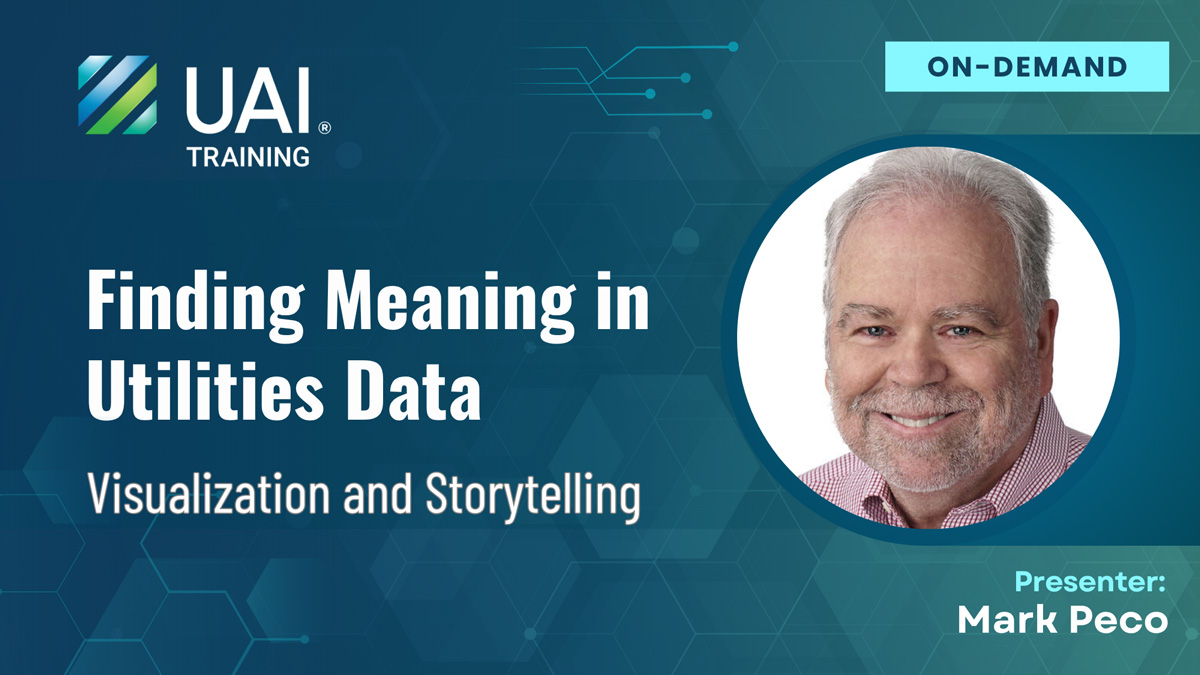
Mark Peco is an experienced consultant, educator, practitioner, and manager in the fields of Business Intelligence and Process Improvement. He provides vision and leadership to projects operating and creating solutions at the intersection of Business and Technology. Mark is actively involved with clients working in the areas of Strategy Development, Process Improvement, Data Management and Business Intelligence. He holds graduate and undergraduate degrees in engineering from the University of Waterloo and has led numerous consulting and integration projects helping clients adapt to fundamental shifts in business models and requirements.
His experience includes real time process monitoring and control, operations planning and scheduling, control center management, plant performance optimization, business transaction control, simulation, and analytics. He has worked in the fields of Data Warehousing and Business Intelligence since the mid 1990’s complementing his earlier experience gained in as an engineer working in operations management during the 1980s.
Mark has integrated his communications skills with his domain expertise to create educational content and deliver courses and workshops for BI and DW Professionals on a global basis for more than a dozen years. He enjoys helping professionals with diverse backgrounds develop common perspectives and share new levels of understanding about complex concepts and subjects.
Mark has worked extensively in the energy sector and understands the business context, operations challenges, and business intelligence opportunities available to help management solve difficult issues and improve operating results.